
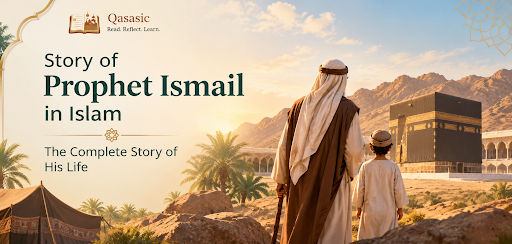
 The story of Prophet Ismail in Islam is one of the most powerful stories in the Qur’an. It tells of faith, patience, obedience, sacrifice, family, and complete trust in Allah. Prophet Ismail (peace be upon him) was the son of Prophet Ibrahim (Abraham) and is remembered in Islam as a prophet, a truthful man, and one of Allah’s righteous servants.
His life is closely connected with Makkah, the Zamzam well, the Kaaba, and the foundations of several important acts of worship performed by Muslims today. The Qur’an praises Ismail for his patience, truthfulness, prayer, and obedience to Allah.
The Qur’an mentions Prophet Ismail in several places, including Surah Al-Baqarah, Surah Ibrahim, Surah Maryam, Surah Al-Anbiya, Surah As-Saffat, and Surah Al-An’am. His story is also explained through authentic narrations in Sahih al-Bukhari.
Who Was Prophet Ismail in Islam?
Prophet Ismail (peace be upon him) was the son of Prophet Ibrahim (peace be upon him). The authentic hadith literature describes how Ibrahim brought Ismail and his mother to the valley of Makkah while Ismail was still a young child.
The Qur’an specifically identifies Ismail as a prophet and messenger. Allah says:
“And mentioned in the Book, Ishmael. Indeed, he was true to his promise, and he was a messenger and a prophet.”
Allah further says that Ismail commanded his family to establish prayer and give charity, and that he pleased his Lord. Qur’an 19:54–55
This description shows that Prophet Ismail was not only connected with the history of Makkah but was also a prophet who guided his family toward obedience to Allah.
Prophet Ibrahim Takes Ismail and His Mother to Makkah
One of the most important parts of the story begins when Prophet Ibrahim brought Ismail and his mother to the barren valley of Makkah.
According to Ibn Abbas in Sahih al-Bukhari 3364, Ibrahim brought Ismail’s mother and her infant son to a place near the future site of the Kaaba. At that time, no people lived there, and there was no source of water.
Ibrahim left them with some dates and a small container of water. Ismail’s mother asked why he was leaving them in a valley with no people. When she understood that Allah had commanded him to do so, she accepted Allah’s decision and trusted Him.
This moment shows Ismail’s mother’s extraordinary faith and trust in Allah.
The Qur’an records Ibrahim’s prayer:
“Our Lord! I have settled some of my descendants in an uncultivated valley near Your Sacred House, our Lord, that they may establish prayer…”
Ibrahim then asked Allah to make people’s hearts incline toward them and to provide them with provisions.
The Miracle of Zamzam
After the water, Ibrahim left with Ismail, and his mother ran out; Ismail’s mother searched for help.
The authentic narration in Sahih al-Bukhari 3364 explains that she went between the hills of Safa and Marwa seven times, searching for someone who might help them. During this difficult time, Allah provided a miraculous source of water.
An angel came to Zamzam, and water began to flow. Ismail’s mother gathered the water and contained it.
The Prophet Muhammad ﷺ later praised Ismail’s mother and said that if she had left the water flowing, Zamzam would have become a flowing stream.
This authentic narration connects Ismail’s story with the Islamic practice of walking between Safa and Marwa during Hajj and Umrah. Ismail’s mother’s actions became part of the rituals Muslims around the world remember.
The Arrival of the Jurhum People
The appearance of water eventually attracted people travelling through the region. According to the detailed narration in Sahih al-Bukhari 3364, people from the tribe of Jurhum noticed birds flying around the area and realised that water might be present.
They approached Ismail’s mother and asked for permission to settle there. She agreed, and the area gradually became inhabited.
Ismail grew up among the people of Makkah. The barren valley where he had initially been left became a place of settlement and eventually developed into the sacred city associated with the Kaaba.
Read Also: Story of Prophet Yusuf in Islam: His Life & Lessons
Prophet Ismail and the Building of the Kaaba
One of the most important parts of the story of Prophet Ismail is his role in building the Kaaba with his father, Prophet Ibrahim.
The Qur’an explicitly mentions both Ibrahim and Ismail in connection with the Sacred House. Allah says:
“And We entrusted Abraham and Ishmael to purify My House for those who circle it, those who remain there in worship, and those who bow and prostrate themselves in prayer.”
Qur’an 2:125
Another verse says:
“And remember when Abraham raised the foundation of the House with Ishmael…”
Qur’an 2:127
The Qur’an therefore clearly establishes that Ibrahim and Ismail helped raise the foundations of the Sacred House.
An authentic narration in Sahih al-Bukhari 3365 provides additional details. Ibrahim came to Ismail while Ismail was near the Zamzam well. Ibrahim told him that Allah had commanded him to build a house for Him.
Ismail agreed to help his father.
Ibrahim began building the Kaaba while Ismail brought him stones. As they worked, both of them made the famous supplication:
“Our Lord, accept this from us. Indeed, You are the All-Hearing, the All-Knowing.”
Qur’an 2:127
This shows that even while performing a great act of worship, they remained humble and asked Allah to accept their efforts.
The Trial of Sacrifice
Perhaps the most famous part of the story of Prophet Ismail is the test of sacrifice.
The Qur’an describes how Prophet Ibrahim prayed for righteous offspring. Allah gave him the good news of a forbearing son.
When the son became old enough to work alongside his father, Ibrahim told him that he had seen in a dream that he was to sacrifice him. Instead of resisting, the son responded with remarkable submission:
“O my dear father! Do as you are commanded. Allah willing, you will find me steadfast.”
Qur’an 37:102
The Qur’an does not name the son in this passage. Classical Islamic tradition identifies this son as Ismail, and this is the commonly held interpretation among Muslim scholars. Therefore, when presenting the Qur’anic account precisely, it is important to acknowledge that the verse itself says “the son” without naming him.
The father and son submitted themselves to Allah’s command. When Ibrahim was about to carry out the sacrifice, Allah called to him and stopped the sacrifice.
Allah says:
“You have fulfilled the vision.”
Qur’an 37:105
Allah then provided a great sacrifice instead.
The event became one of the central reminders associated with Eid al-Adha, when Muslims around the world offer an animal sacrifice in remembrance of Ibrahim’s obedience and submission to Allah.
The story shows that true faith means trusting Allah even during the hardest tests.
Prophet Ismail Was Known for Patience
Prophet Ismail’s life was marked by patience from childhood.
He grew up in a difficult environment, faced the hardships of life in Makkah, and helped build the Kaaba. His response to the test described in Surah As-Saffat also demonstrates extraordinary patience and submission.
Allah says:
“And Ishmael, Idris, and Dhul-Kifl—all were steadfast.”
Qur’an 21:85
The Qur’an therefore directly connects Ismail with steadfastness.
His patience was not simply passive endurance. It was patience combined with obedience, trust, and action.
Prophet Ismail Was Truthful
Another quality Allah specifically mentions is Ismail’s truthfulness.
Allah says:
“Indeed, he was true to his promise, and he was a messenger and a prophet.”
Qur’an 19:54
Keeping promises is an important quality in Islam. The Qur’an highlights this characteristic as part of Ismail’s noble character.
His example teaches Muslims that faith is demonstrated not only through major acts of worship but also through everyday honesty and keeping one’s word.
Prophet Ismail Guided His Family
Prophet Ismail also cared about his family’s worship and spiritual well-being.
Allah says:
“And he used to enjoin prayer and charity upon his people and was pleasing to his Lord.”
Qur’an 19:55
This teaches an important lesson about family responsibility. A believer should not only focus on personal worship but should also encourage family members toward prayer, charity, and obedience to Allah.
Read Also: Story of Prophet Nuh in Islam: A Complete Quranic Story
ProphetI Ismail’s Role in the History of Makkah
Ismail’s life is deeply connected to Makkah.
The authentic hadith about Ismail and his mother explains the development of the settlement around Zamzam. Later, Ismail helped his father lay the foundations of the Kaaba.
Because of this connection, Prophet Ismail’s story is closely associated with several major elements of Islamic worship, including:
- The Kaaba
- Zamzam
- Safa and Marwa
- Makkah
- Hajj and Umrah
- The sacrifice associated with Eid al-Adha
These connections make his story especially important for Muslims visiting Makkah for Hajj or Umrah.
What Can Muslims Learn From Prophet Ismail?
The story of Prophet Ismail provides many important lessons.
1. Trust Allah in Difficult Situations
Ismail’s mother trusted Allah when she and her child were left in a barren valley. Allah eventually provided Zamzam and transformed the area into a place of life and worship.
Reference: Qur’an 14:37; Sahih al-Bukhari 3364
2. Be Patient During Trials
The Qur’an describes Ismail as one of those who were steadfast.
Reference: Qur’an 21:85
3. Keep Your Promises
Allah specifically praised Ismail for keeping his promise.
Reference: Qur’an 19:54
4. Obey Allah
The son’s response in the sacrifice story shows complete submission to Allah’s command.
Reference: Qur’an 37:102–107
5. Build and Serve With Sincerity
When Ibrahim and Ismail raised the foundations of the Kaaba, they asked Allah to accept their work.
Reference: Qur’an 2:127
6. Encourage Your Family Toward Worship
Ismail commanded his family to establish prayer and give charity.
Reference: Qur’an 19:55
Conclusion: The Legacy of Prophet Ismail in Islam
The story of Prophet Ismail in Islam is a story of faith that continues to influence Muslim worship today. From the waters of Zamzam to the journey between Safa and Marwa and the building of the Kaaba, his life is closely connected with the sacred history of Makkah.
Prophet Ismail (peace be upon him) was a prophet who demonstrated patience, truthfulness, obedience, and trust in Allah. His cooperation with Prophet Ibrahim in raising the foundations of the Kaaba remains one of the most important events mentioned in the Qur’an.
His story also reminds Muslims that great acts of worship require sincerity and humility. Ibrahim and Ismail did not simply complete the construction of the Sacred House; they prayed that Allah would accept their work.
Prophet Ismail’s legacy is therefore not only found in historical events. It continues through prayer, Hajj, Umrah, Zamzam, sacrifice, and the devotion of Muslims who turn toward the Kaaba every day.